

A Complete Guide to Understanding Variations, Nations, Linguistic Variants, Functions, and Usage for Hot-Market Targeting
Introduction
In the vast and rich tapestry of Afro-Brazilian spiritual traditions, few objects carry as much power, symbolism, and practical significance as the guias—the sacred necklaces and bracelets worn by practitioners of Umbanda and related traditions. These are not mere adornments or fashion accessories. They are instruments of magic, barriers against negative energies, symbols of spiritual connection, and markers of identity that communicate a practitioner’s lineage, level of initiation, and spiritual affiliations.
Yet despite their central importance in Umbanda practice, a troubling reality persists: most practitioners buy and wear guias without fully understanding their powers, their proper uses, or the profound foundations that govern them. As one Umbanda teacher laments, “The lack of concern with the foundations is leaving aside important knowledge. And more: it is causing sacred magical objects to be used in a profane manner! And profane objects are used as if they were sacred, since there is no longer current and easily accessible information”.
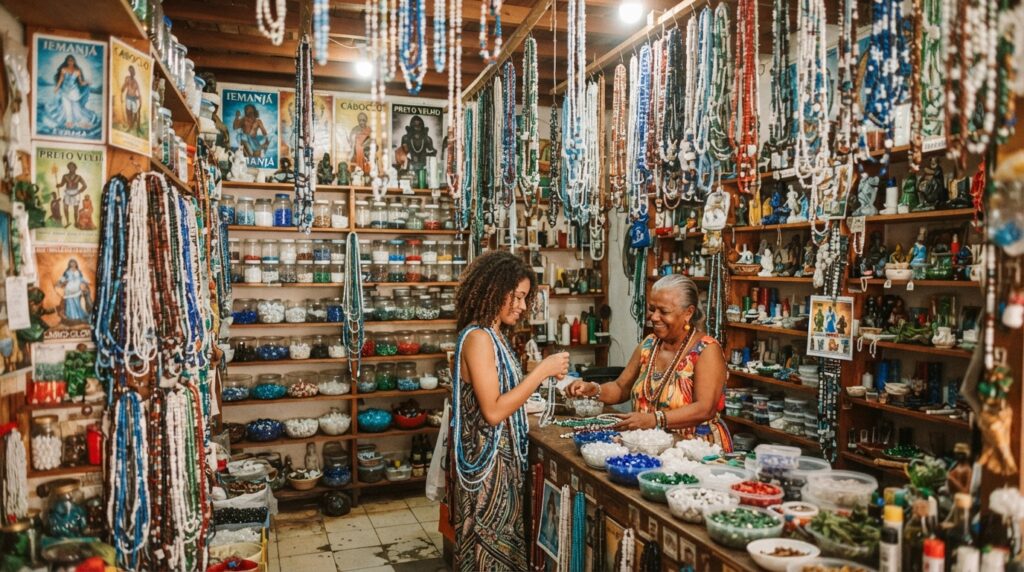
This gap between the sacred significance of guias and the practical knowledge of practitioners represents both a spiritual challenge and a significant market opportunity. For those who create, sell, or provide guidance on Umbanda guias, necklaces, and bracelets, the ability to inform the foundations—to educate clients on the variations, nations, linguistic variants, functions, and proper forms of use—is the key to attracting what marketers call “hot” clients: deeply engaged, spiritually aware consumers who seek authenticity, knowledge, and meaningful connection.
This article provides a comprehensive guide to understanding the foundations of Umbanda guias and related spiritual jewelry, structured to optimize search visibility and attract the right audience. Drawing on traditional knowledge, contemporary practice, and modern SEO principles, we will explore the variants of foundations, the distinct nations within Afro-Brazilian traditions, the linguistic variations that reflect different cultural origins, the specific functions of different types of guias, and the correct forms of use that distinguish authentic practice from mere ornamentation.
Chapter 1: What Are Guias? Understanding the Sacred Adornment
1.1 Definition and Etymology
The term guia in the context of Afro-Brazilian religions refers to the sacred necklaces, bracelets, and other adornments worn by practitioners during spiritual sessions (giras) and, in some cases, in daily life. The word itself carries a dual meaning: it refers both to the physical object—the necklace or bracelet made of beads, crystals, or seeds—and to the spiritual entity—the guiding spirit or orixá that the object represents.
This linguistic duality is not coincidental. The physical guia is understood to be a material manifestation of the spiritual connection between the practitioner and their guiding entities. When a practitioner wears a guia, they are not simply displaying an object; they are carrying the energy and presence of their spiritual guides.
1.2 The Magical Foundation
The use of necklaces, bracelets, and talismans is “as old as humanity itself”. In Umbanda, however, these objects are understood through a specific magical framework:
The Circle as Sacred Space: A necklace, ring, bracelet, or tiara is, in its essence, a circle. The circle is a magical space—a contained area that can be consecrated and used for one or more functions by its possessor. Whether a rigid circle (like a ring or crown) or a flexible one (like a necklace that moves with the wearer), the circular form creates a boundary that can hold spiritual energy and provide protection.
Protection Against Negative Influences: The popular understanding of guias as protectors against envy, the evil eye, negative fluids and vibrations, spiritual attachments, and negative magic reflects a deeper esoteric truth. The guia functions as a spiritual shield, absorbing negative accumulations from the electromagnetic fields and protecting the medium against harmful influences during spiritual work.
Conservation and Connection: For the medium, the guia is not merely an accessory but an instrument of work. It serves to conserve the medium in balance and connect them with spirituality, creating a protective field.
1.3 The Distinction Between Sacred and Profane
A critical distinction in Umbanda practice is that between the sacred and the profane. A guia is not simply a necklace; it is a consecrated object that must be properly prepared and activated. The process of consecration—often called cruzar (to cross)—involves ritual actions by spiritual entities or qualified priests that transform a collection of beads into a living spiritual tool.
This is why the lack of foundational knowledge is so concerning: when guias are worn without proper understanding or consecration, sacred objects are used profanely, and their spiritual power is diminished or lost entirely.
Chapter 2: The Nations — Understanding the Variants of Foundations
2.1 What Are “Nations” in Afro-Brazilian Traditions?
In the context of Afro-Brazilian religions, nações (nations) refer to distinct cultural, linguistic, and ritual lineages that trace their origins to specific African ethnic groups. These nations represent different streams of spiritual tradition, each with its own language, deities, rituals, and—crucially for our purposes—its own approaches to the creation and use of sacred adornments.
The primary nations relevant to Umbanda and related traditions include:
| Nation | Origin | Primary Deities | Linguistic Base | Key Characteristics |
|---|---|---|---|---|
| Ketu (or Nagô) | Yoruba people (Nigeria/Benin) | Orixás | Yoruba | Most widely recognized; emphasis on orixás; rich mythological tradition |
| Jeje | Fon people (Dahomey/Benin) | Voduns | Fon | Venerates voduns rather than orixás; distinct rituals and chants |
| Angola/Congo | Bantu peoples (Angola/Congo) | Inkices (or Mukixes) | Kimbundu/Kikongo | Different nomenclature for deities; distinct ritual practices |
| Caboclo | Indigenous Brazilian | Caboclo spirits | Portuguese/Tupi | Incorporates indigenous Brazilian spiritual traditions |
2.2 How Nations Influence Guias
The nation to which a practitioner or house (terreiro) belongs significantly influences the materials, colors, patterns, and consecration rituals associated with their guias. Some key differences include:
Nomenclature of Deities: What is called an orixá in the Ketu nation may be called a vodum in Jeje or an inkice in Angola/Congo. This affects how the guia is understood and named.
Color Associations: While there are general associations between colors and specific deities, these can vary significantly between nations. For example, the color associations for Oxum differ between Candomblé and Umbanda traditions.
Materials: Different nations may favor different materials—certain types of beads, seeds, shells, or crystals—based on their specific traditions and the natural resources available in their regions of origin.
Consecration Rituals: The rituals for consecrating and “crossing” guias vary between nations and even between individual houses within the same nation.
2.3 Implications for Marketing and Client Education
Understanding the nation-based variations in guia traditions is essential for anyone selling or providing guidance on these sacred objects. A “one-size-fits-all” approach to guias is not only spiritually inappropriate but also commercially limiting. Informed clients—those who understand the significance of nations—will seek out sellers and practitioners who demonstrate this knowledge.
To attract “hot” clients, you must be able to:
- Identify which nation a client’s practice or house belongs to
- Provide appropriate guidance on the correct guias for that tradition
- Explain the variations in materials, colors, and patterns
- Respect the specific consecration requirements of different nations
Chapter 3: Linguistic Variants — The Language of the Sacred
3.1 The Multilingual Reality of Afro-Brazilian Traditions
Afro-Brazilian spiritual traditions are inherently multilingual. The languages of the African diaspora—Yoruba, Fon, Kimbundu, Kikongo—mix with Portuguese and indigenous languages to create a rich linguistic tapestry. This multilingual reality is reflected in the terminology used for sacred objects:
| Object | Yoruba (Ketu) | Fon (Jeje) | Kimbundu (Angola) | Portuguese (Umbanda) |
|---|---|---|---|---|
| Sacred necklace | Àkufi isiro or Ìlèkè | Varies | Varies | Guia, fio de conta, colar de santo |
| Deity | Orixá | Vodum | Inkice or Mukixe | Guia espiritual or entidade |
| Spiritual energy | Axé | Ashe | Nxila | Axé (adopted) |
3.2 Why Linguistic Knowledge Matters
For those marketing guias and related products, understanding and using the correct terminology is crucial for several reasons:
Authenticity: Using the appropriate linguistic terms for a client’s tradition demonstrates respect and knowledge. A client from a Jeje house will respond differently to the term vodum than to orixá.
Search Optimization: Including linguistic variants in your content helps capture searches from practitioners who use different terminology. Someone searching for “Ìlèkè” is likely to be more deeply engaged than someone searching for “Umbanda necklace.”
Educational Value: Explaining the linguistic origins of terms educates clients and builds trust. When you can explain that Àkufi isiro is the Yoruba term for a sacred necklace, you position yourself as an authority.
3.3 Practical Application
In your marketing content, product descriptions, and client interactions, consider including:
- The Portuguese/Umbanda term (guia, fio de conta)
- The Yoruba term (Àkufi isiro, Ìlèkè)
- Brief explanations of linguistic origins
- Clarification of which terms are appropriate for which traditions
This approach serves both educational and commercial purposes: it attracts informed clients and helps educate those who are still learning.
Chapter 4: Functions — What Guias Actually Do
4.1 Protection
The most fundamental function of a guia is protection. This protection operates on multiple levels:
Against Negative Energies: Guias function as barriers against envy, the evil eye, negative fluids and vibrations, spiritual attachments, and negative magic. They “absorb the negative accumulations of electromagnetic fields, protecting the mediums against bad influences during work”.
As a “Lightning Rod”: One traditional description calls guias “true lightning rods in defense of mediums”. When a medium enters into contact with energies they could not otherwise withstand, the guia serves as a buffer.
Daily Protection: While some guias are used only during ritual work, “guia de proteção” (protection guias) may be worn daily by both mediums and non-mediums seeking spiritual safeguarding.
4.2 Connection and Identification
Beyond protection, guias serve as instruments of connection:
Connection to Orixás and Entities: The guia represents and connects the wearer to their specific orixá or spiritual entity. Each color, material, and pattern corresponds to specific spiritual energies.
Identification of Spiritual Affiliation: By observing the guias a person wears, knowledgeable observers can identify:
- Which orixá or entity guides them
- Their level of initiation or spiritual development
- Which “line” (linha) of Umbanda they work within
- Their nation or tradition
Identification of Function: Specific guias identify specific roles within the spiritual community. For example, a medium working at the porteira (gateway) of a terreiro may wear guias crossed differently from those of other mediums.
4.3 Absorption and Transformation
Guias are understood to actively absorb and transform spiritual energies:
Absorption of Negativity: As mentioned, guias absorb negative energies, preventing them from affecting the wearer.
Transformation of Energy: Through the consecration process, guias become active “magical spaces” that can transform energy.
Signs of Function: When a guia breaks or its beads fall off, this is often interpreted as a sign that it has absorbed significant negative energy—it has “fulfilled its function” of protection.
4.4 Ritual Function
During spiritual work, guias serve specific ritual functions:
Passes: Guias may be used during passes (energetic transmissions) given to clients during work days.
Ritual Identification: Different guias may be worn for different types of work—for example, specific guias for giras de esquerda (left-hand work) versus regular sessions.
Consecration Tools: The guia itself is a tool of consecration; its presence and use in ritual helps maintain the spiritual integrity of the space and participants.
Chapter 5: Forms of Use — How to Wear and Care for Guias
5.1 Who Can Wear Guias?
A common question is whether guias are only for initiated mediums or if anyone can wear them.
Guias de Proteção: Protection guias can be worn by “any person,” including non-mediums and consulentes (clients seeking spiritual guidance). These are typically simpler in design and are intended for daily spiritual safeguarding.
Guias de Trabalho: Work guias—those that represent specific entities, lines of work, or levels of initiation—are typically only for initiated mediums who have received them through proper ritual channels.
Guidance from Spiritual Entities: In many traditions, guias are only to be made and worn after a specific entity has requested them. The entity provides guidance on the specific characteristics, colors, and function needed.
5.2 Correct Positioning
The way a guia is worn is significant:
Frontal Positioning: In many Umbanda houses, guias are worn frontally—hanging down the front of the body rather than wrapped around the neck in multiple loops.
Length: The guia should hang to a length that extends two to three fingers below the navel, providing protection to the chakras.
Crossed Guias: Some traditions use guias crossed over the body, but this is typically reserved for specific functions (such as mediums working at the porteira).
5.3 Care and Maintenance
Proper care of guias is essential:
Storage: Guias should be stored in clean, reserved places. They should not be left in disrespectful locations.
Handling: “Other people should not touch them unnecessarily”. The spiritual energy of a guia is specific to its wearer; contact by others can disrupt this energy.
Respect: Guias should be “respected and cared for as a sacred object”.
Replacement: If a guia breaks, this is typically interpreted as a sign that it has fulfilled its protective function and should be replaced.
5.4 When to Wear
During Spiritual Work: Guias are typically worn during giras (sessions) and other ritual activities.
Daily Wear: Protection guias may be worn daily, but work guias are often reserved for ritual contexts.
Following Entity Guidance: The ultimate authority on when to wear a guia is the spiritual entity who requested it. “The spiritual guide is the only one who knows how to handle and activate the resources of the necklace with 100% knowledge of the subject”.
Chapter 6: Colors and Their Meanings — A Comprehensive Guide
6.1 General Color Associations
The colors of guia beads carry specific meanings. While there is variation between traditions and houses, the following associations are widely recognized:
6.2 Pattern and Sequence
Beyond individual colors, the pattern or sequence of beads carries meaning. For example:
- Exu: 3 red beads, 3 black beads (sequentially)
- Pomba Gira: 1 red bead, 1 black bead (sequentially)
- Ogum: 3 red, 3 green (sequentially)
- Omolu: 3 black, 3 white (sequentially)
- Oxóssi: 3 green, 3 white (sequentially)
These patterns are not arbitrary; they encode specific energetic signatures that connect the wearer to their guiding entities.
6.3 Regional and House Variations
It is crucial to note that colors can change according to the region. What is standard in one house or region may differ in another. This is why informed guidance from knowledgeable practitioners is essential.
Chapter 7: The Marketing Opportunity — Why Information Attracts “Hot” Clients
7.1 Understanding “Hot” Clients
In marketing terms, a “hot” client is one who is:
- Highly engaged: They are actively seeking information and solutions
- Knowledgeable: They understand at least the basics of what they’re looking for
- Ready to purchase: They have intent and are close to making a decision
- Quality-focused: They value authenticity and expertise over price
For those selling guias and related products, hot clients are those who understand the foundations—who recognize that a guia is not just a piece of jewelry but a sacred object with specific requirements.
7.2 The Information Gap as Opportunity
The gap between the sacred significance of guias and the practical knowledge of many practitioners creates a significant market opportunity. As noted earlier, “most Umbandistas buy guias and necklaces, bracelets, etc. without knowing for sure their powers or uses”.
This information gap means that:
- Informed sellers who can educate their clients will stand out
- Educational content that explains foundations will attract engaged audiences
- Clients who understand the foundations are more likely to purchase appropriate products and return for future purchases
7.3 What “Hot” Clients Are Looking For
Based on the foundations discussed above, hot clients in the guia market are seeking:
Authenticity: They want guias that are made according to proper traditions, using appropriate materials and patterns.
Knowledge: They want to understand what they are buying—the meaning of colors, the significance of patterns, the proper ways to wear and care for their guia.
Guidance: They want to know which guia is right for them, based on their specific spiritual affiliations and needs.
Quality: They are willing to pay for well-made guias that use appropriate materials.
Connection: They want to feel that the guia they purchase is spiritually meaningful, not merely decorative.
7.4 How to Attract “Hot” Clients
To attract hot clients, your marketing and content strategy should focus on:
Educational Content: Create detailed guides explaining the foundations of guias—the nations, the colors, the patterns, the proper use.
Transparency: Be clear about what you offer, how your guias are made, and what traditions they follow.
Authority: Demonstrate your knowledge through detailed, accurate content that references traditional sources.
Personalization: Offer guidance to help clients find the right guia for their specific needs and traditions.
Respect: Show respect for the traditions you are representing. This is not just good ethics—it’s good marketing.
Chapter 8: SEO Strategy for Guia Marketing
8.1 Understanding the Search Landscape
The search landscape for Umbanda guias includes diverse audiences with varying levels of knowledge:
| Search Intent | Example Queries | User Profile |
|---|---|---|
| Educational | “O que significa guia na Umbanda” | Learning, may not be ready to purchase |
| Practical | “Como fazer guia de Umbanda” | DIY interest, may purchase materials |
| Commercial | “Comprar guia de Oxalá” | Ready to purchase |
| Specialized | “Guia de Exu 3 vermelhas 3 pretas” | Highly knowledgeable, specific needs |
8.2 Semantic Keyword Strategy
To capture the full range of potential clients, your content should include:
Primary Keywords:
- Guia de Umbanda
- Colar de Umbanda
- Fio de conta
- Pulseira de Umbanda
Long-Tail Keywords (capturing specific needs):
- “Guia de proteção Umbanda significado”
- “Cores das guias dos Orixás”
- “Como usar guia de Umbanda corretamente”
- “Guia de Exu 3 vermelhas 3 pretas”
Educational Keywords (attracting learning audiences):
- “Fundamentos das guias na Umbanda”
- “O que significa cada cor na guia de Umbanda”
- “Nações de Umbanda diferenças”
- “Como consagrar guia de Umbanda”
Linguistic Variants (capturing diverse traditions):
- “Àkufi isiro” (Yoruba)
- “Ìlèkè” (Yoruba)
- “Fio de conta” (Portuguese)
- “Colar de santo” (Portuguese)
8.3 Content Structure for SEO
Based on the successful patterns from the case studies referenced in previous articles, organize your content to:
- Answer the primary question thoroughly (e.g., “What are Umbanda guias and why do they matter?”)
- Address related questions users might have (How are they made? What do colors mean? Who can wear them?)
- Include relevant entities (orixás, nations, colors, materials, consecration rituals)
- Provide practical information (how to choose, how to wear, how to care for guias)
- Feature expert insights (drawing on traditional knowledge and contemporary practice)
- Include visual elements (images of guias, color charts, pattern diagrams)
8.4 Structured Data for Guia Content
Implement schema markup to help search engines understand your content:
- Product Schema: For individual guias for sale
- Article Schema: For educational content about guias
- FAQ Schema: For common questions about guias
- HowTo Schema: For guides on making or using guias
8.5 FAQ Section for AI Visibility
Including FAQ sections in your content increases visibility in AI search results. Consider these questions:
- O que é uma guia na Umbanda?
- Qual o significado das cores das guias?
- Quem pode usar guia de proteção?
- Como devo usar minha guia de Umbanda?
- Qual a diferença entre guia de trabalho e guia de proteção?
- O que significa quando uma guia quebra?
- Como devo cuidar da minha guia?
- Posso usar guia de outro orixá que não o meu?
Chapter 9: Practical Applications — Examples for Different Audiences
9.1 For the Curious Beginner
Profile: Someone who has recently discovered Umbanda or is exploring Afro-Brazilian spirituality. They may not have an orixá de cabeça or a specific spiritual affiliation yet.
Recommended Content: Educational articles explaining what guias are, their basic functions, and how they are used. Simple guides to understanding colors.
Product Recommendation: Protection guias (generally white, or simple designs) that can be worn for general spiritual safeguarding.
Marketing Approach: Focus on education and accessibility. Use welcoming language. Explain the basics without assuming prior knowledge.
9.2 For the Practicing Medium
Profile: Someone who is already active in a terreiro, has an orixá de cabeça, and receives guidance from spiritual entities. They may need specific guias for their work.
Recommended Content: Detailed guides on specific guias (e.g., “Guia de Oxalá: significado e uso”), explanations of patterns and sequences, guidance on care and maintenance.
Product Recommendation: Specific guias for their orixá de cabeça, work guias for different types of sessions, additional guias as requested by their entities.
Marketing Approach: Emphasize authenticity and quality. Show respect for traditions. Provide detailed information that demonstrates expertise.
9.3 For the House Leader (Pai/Mãe de Santo)
Profile: Someone who leads a terreiro and may need guias for their house members, or who provides guidance on guia use to their community.
Recommended Content: In-depth articles on the variations between nations, advanced guidance on consecration, explanations of the distinctions between different traditions.
Product Recommendation: Bulk orders of guias for house members, custom guias for specific functions within the house.
Marketing Approach: Position yourself as a knowledgeable partner. Offer customization. Demonstrate deep understanding of different traditions and their requirements.
9.4 For the DIY Enthusiast
Profile: Someone who wants to make their own guias, either for personal use or for sale.
Recommended Content: Tutorials on making guias, guidance on materials and techniques, explanations of the significance of different patterns.
Product Recommendation: Materials for making guias—beads, crystals, seeds, cord, findings.
Marketing Approach: Provide practical, actionable information. Offer quality materials. Emphasize the importance of proper consecration.
Chapter 10: Ethical Considerations in Marketing Guias
10.1 Respect for Sacred Traditions
The marketing of guias and other sacred objects carries a heavy ethical responsibility. These are not merely products; they are instruments of faith that carry deep spiritual significance for millions of practitioners.
Do:
- Represent traditions accurately and respectfully
- Acknowledge the diversity of traditions and practices
- Provide education alongside commercial offerings
- Work with knowledgeable practitioners to ensure accuracy
Don’t:
- Make claims that cannot be substantiated
- Misrepresent the traditions or their requirements
- Treat sacred objects as mere fashion accessories
- Exploit the vulnerability of those seeking spiritual guidance
10.2 Transparency About Limitations
As with the disclaimers recommended for cartomancy services, transparency is essential in marketing guias:
“Guias are sacred objects used in Afro-Brazilian spiritual traditions. Their proper use requires knowledge of the specific traditions, proper consecration, and appropriate guidance. While protection guias may be worn by anyone seeking spiritual safeguarding, work guias are typically reserved for initiated mediums. We recommend seeking guidance from qualified practitioners within your tradition.”
10.3 The Balance of Commerce and Faith
The commercialization of sacred objects is a sensitive topic. Ethical marketing requires finding a balance between:
- Making these objects accessible to those who need them
- Respecting the sacred nature of the objects
- Providing fair compensation for the work of creating them
- Avoiding exploitation or profiteering
Conclusion
Umbanda guias, necklaces, and bracelets are far more than decorative accessories. They are sacred instruments that carry the weight of centuries of tradition, the power of spiritual connection, and the deep significance of Afro-Brazilian faith. Understanding their foundations—the variants of nations, the linguistic diversity, the specific functions, and the proper forms of use—is essential for both practitioners and those who serve them.
For marketers, artisans, and sellers in this space, the ability to inform the foundations is the key to attracting “hot” clients—those who are deeply engaged, spiritually aware, and seeking authenticity. By providing comprehensive, accurate, and respectful information about the traditions, you position yourself not just as a seller but as a trusted guide in the spiritual journey of your clients.
The information gap identified by traditional practitioners—”the lack of concern with the foundations”—represents both a challenge and an opportunity. Those who can bridge this gap, who can educate while they serve, who can respect tradition while meeting contemporary needs, will find a loyal and engaged audience.
As the case studies from previous articles demonstrated, there is no single way to serve the spiritual community. There is your way—your unique approach to combining knowledge, service, and commerce in a way that honors the traditions and serves the needs of those seeking connection to the sacred.
Whether you are creating guias, selling them, or providing guidance on their use, the principles are the same: know the foundations, share the knowledge, and serve with respect.
References
- Casa do Vô Benedito. (n.d.). Guias. Retrieved from https://www.casadovobenedito.com
- Extra Globo. (2014). A importância das Guias e dos Fios de contas. Retrieved from https://extra.globo.com
- Raízes Espirituais. (2018). Guias e colares de contas: como e por quê eles são usados na Umbanda? Retrieved from https://www.raizesespirituais.com.br
- Umbanda Eu Curto. (n.d.). Guias e colares na Umbanda: fundamentos para fazer e usar. Retrieved from https://umbandaeucurto.com
- Wikipédia. (2019). Guia (adereço). Retrieved from https://pt.wikipedia.org
- Todas as Respostas. (n.d.). Qual o significado das cores das guias na Umbanda? Retrieved from https://todasasrespostas.pt
- Axé News. (2025). Você sabe o verdadeiro poder das guias na Umbanda? Retrieved from https://www.axenews.com.br
- Umbandista Novato. (2025). Vibração, Cor e Proteção: Desvendando os Fios de Contas e Guias na Umbanda. Retrieved from https://umbandistanovato.com.br
- Coda.io. (n.d.). Guias · Abassá Amor e Fraternidade – Caminhos de Ogum. Retrieved from https://coda.io
- Joia Mística Laroyê. (2026). Nações do candomblé: Ketu, Jeje e Angola. Retrieved from https://joiamisticalaroye.com.br
- Terreiro de Umbanda. (n.d.). As Sete Linhas de Umbanda. Retrieved from https://www.terreirosdeumbanda.com.br
- WebArtigos. (n.d.). GUIAS OU COLARES NA UMBANDA. Retrieved from https://www.webartigos.com
Download the Astral Lens.
The astrological tool for the Android system